Halftones
Rosette
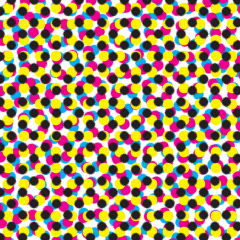
A rosette is the small flower-shaped pattern formed where correctly angled CMYK halftone screens overlap, and its presence confirms the separations are angled right.
A rosette is the flower-shaped cluster that forms where cyan, magenta, yellow, and black dots overlap at their standard 15/45/75/0 angles. The pattern repeats at the screen ruling, so at 55 lpi one cluster occupies roughly 0.018 inch and takes a 10x loupe to resolve on a shirt. Two forms exist: dot-centered, with a black dot in the middle, and clear-centered, with a small open hole. Both are correct — the difference is a half-cell shift in where the four screens land.
For a buyer this pattern is a quality signal, not a feature. We loupe the first good pull on every four-color job before releasing the run, because a rosette that has collapsed into stripes means an angle is wrong or a film went out at the wrong resolution, and that is a 400-piece decision made in the first three shirts.
Given the option in a RIP, screen printers usually take the dot-centered form. Registration drifts on a press — a quarter millimeter of pallet play across 400 pieces is ordinary — and a clear-centered rosette shifts color as its hole closes, while a dot-centered one holds. The cost is a slightly grainier look at low rulings. Below 45 lpi on 200 mesh that grain is genuinely ugly, and index or simulated process beats fighting for a clean pattern.
Customers spot the texture in a proof, call the print dotty, and ask to have it taken out. It cannot be taken out of four-color process, because it is the process. The only real exits are a higher ruling, simulated process with opaque spot colors, or index. And the rosette is not the defect anyway: moire, the coarse wandering plaid that shows up once that flower breaks down, is.