Halftones
Dot Percentage
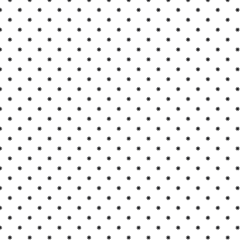
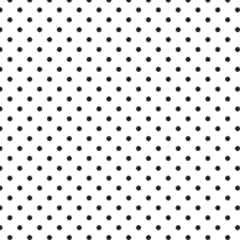
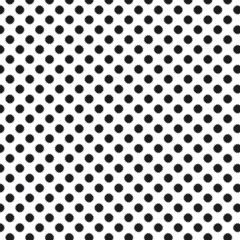
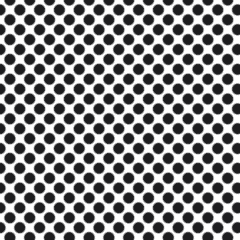
Dot percentage is the share of a given area a halftone dot covers, where 10% reads as a pale tint and 90% as nearly solid ink.
Dot percentage measures coverage, not dot size: it states how much of a single halftone cell the ink fills. At 55 lpi each cell spans about 0.018 inches, so a 50% dot covers half that square whether the shape is round, elliptical, or square. Art files, film positives, and RIP curves all speak in these numbers, and a 5-to-95 step wedge in 5% increments is standard test art in any shop that takes tone seriously. The press then rewrites them: with 12 to 18 microns of emulsion over the mesh and plastisol spreading under a squeegee, a 40% dot on film commonly lands near 55% on a cotton tee.
Dot percentage is the shared vocabulary between the designer and the person on the press, which is why approvals fall apart without it. A customer says "make the gray lighter"; the printer needs to know whether that means 35% instead of 45%, because ten points is the difference between visible texture and a whisper. We lost a 400-piece heather run to exactly this gap: the background sat at 6%, the proof PDF showed it fine, and every one of those dots washed off the screen.
Pros spec dot percentage the way they spec Pantone numbers. Print a step wedge on the actual shirt, ink, and mesh you will run, read it under a 30x loupe, and you learn that your 20% film dot is really a 32% print dot, then build a RIP curve that pulls the file back down. The trade-off is contrast: every point shaved off the shadows to stop plugging also flattens the image.
The common mistake is reading Photoshop's grayscale value as the number the shirt will show. 50% gray on a calibrated monitor is not 50% on a 50/50 blend; it is 50% plus your gain, minus whatever exposure eats out of the highlights.