Halftones
Line Screen Halftone
Line screen halftone renders tone as parallel lines that thicken and thin instead of dots, giving a visible vintage texture that survives coarse fabric and dot gain.
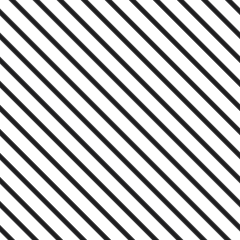
Line screen halftone builds tone out of parallel straight lines whose thickness rises and falls. Twenty percent is a hairline beside a wide gap, 50% is equal line and gap, 80% is a broad bar with a hairline of open shirt left between. Frequency runs coarse on purpose, 10 to 25 lines per inch for the classic worn-in look against 45-55 LPI for a dot screen. Angle is normally 45 or 90 degrees, and at 15 lines per inch each line pair spans 0.067 inch, coarse enough to print clean off 110-160 mesh with a 70-durometer squeegee.
This is a look, not a compromise, and buyers should ask for it by name. Vintage band merch, distressed athletic numbers, single-color photo tees on tri-blends: the stripe reads as deliberate in a way a coarse dot never manages. I had a customer reject a 45 LPI dot version of his artwork as "blurry," then approve the 18 LPI line screen halftone on sight, because the texture looked chosen instead of like a print that almost worked.
Spec it when the fabric is fighting you. Coarse fleece, slub cotton, and heavily textured ring-spun eat fine dots, while lines at 18 per inch carry so much ink per element that gain barely registers. The trade is flattened detail: faces get striped, small type inside the tone fills in, and any fine repeating pattern in the art fights the stripe direction. Keep line screen halftone to one or two colors, since stacking four of them is a plaid waiting to happen.
Mind the vocabulary. Printers also say "line screen" to mean halftone frequency in lines per inch, which is a completely different animal from a halftone made of actual lines. Ask for a "20 LPI straight-line halftone" and nobody on the floor guesses wrong.