Halftones
Hybrid Halftone
Hybrid halftone screening runs AM dots through the midtones and switches to randomized FM dots in highlights and shadows, where AM dots get too small to hold.
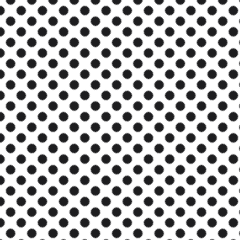
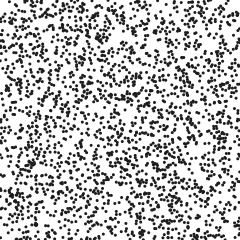
A hybrid halftone runs two screening methods inside a single separation. Through the midtones, typically 10% to 90%, it lays conventional AM dots on a fixed grid at 45 or 55 LPI. Outside that window a 3% AM dot is down to 90 microns at 55 LPI, 110 microns at 45, and 1% is a 52-micron speck no stencil holds, so the RIP pins FM dots near 100 microns and thins their spacing instead. Wasatch, Harlequin, and film RIP hybrid modules let the operator set crossovers by hand: 8% and 92% is common for water-based, 12% and 88% for plastisol on 230 mesh.
What a buyer gets is the part of a print people actually look at, which is the fade into nothing. A hybrid halftone is why a smoke plume or a soft shoulder shadow dissolves into the garment instead of stopping at a hard dot edge. On a black tee portrait, straight AM at 55 LPI leaves a visible terminator where the 4% dots quit; the same file screened hybrid carries tone two stops further down. None of that costs press time. It is a separation and RIP decision made before a screen is ever coated.
Use it on simulated process with long ramps, and on any job where the highlights matter more than the midtones. Set crossovers from your own step wedge rather than the factory default: print a 1-100% strip on the exact garment, find where dots stop reproducing, and put the crossover two points above that. The trade-off is that hybrid highlights gain like FM does, so the top end runs hot if the whole tonal range gets curved as one piece.
The mistake is treating hybrid halftone as a quality button. It rescues the tails of a good separation and does nothing for crushed channels or an underbase printing 100% beneath a 20% highlight. Screening decides how tone renders, never what tone exists.