Halftones
FM (Stochastic) Halftone
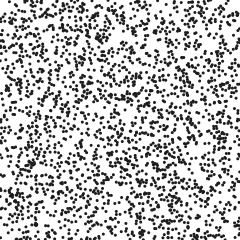
FM halftone screening uses one tiny fixed dot size and varies dot density instead, scattering placement randomly so there is no screen angle and no moire.
FM halftone screening throws out the grid. Every dot is the same size and the RIP decides how many to scatter into a given area, so a 5% tone is a sparse spray and a 60% tone a crowded one, with placement pseudo-random and no angle to beat against another screen or against the mesh. Offset presses run 20-micron stochastic dots. Shirts cannot: a 305 mesh has thread openings near 50 microns, so the practical floor is a 4-6 mil dot, roughly 100-150 microns, big enough for emulsion to anchor and for ink to clear.
Buyers hear "no moire" and want it on everything. Where it earns its keep is art built from tight repeating pattern: a houndstooth jacket inside a photo, fine architectural lattice, a scanned image with somebody else's halftone already baked in. A shop running FM halftone on that art skips the angle chess completely. The bill arrives at the washout sink, because 100-micron dots need 305-355 mesh, 12-15% emulsion over mesh, and exposure inside a narrow window. Twenty seconds long closes them. Twenty seconds short sends them down the drain.
Reach for it when moire risk is genuine and the screen room is dialed in. Gain is the trade. Tiny dots carry enormous edge relative to area, so a 40% film value can land near 60% on a 50/50 tee. Curve it in the RIP before the first pull, usually 12-20% out of the midtones, and pull a step wedge on the actual garment rather than on paper.
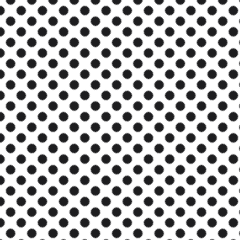
New printers treat stochastic screening as the high-resolution setting. It is not a resolution upgrade, it is a different failure mode. AM loses tone gracefully as dots shrink; an FM halftone goes from perfect to gone on one bad exposure, and the highlights do not fade, they vanish.